

How a Slow Website Is Costing You Leads
Home How a Slow Website Is Costing You Leads
By Nibble Software
0 comments
September 27, 2026
How a Slow Website Is Costing You Leads
You spent money getting people to your website — SEO, Google Ads, social media, referrals. They clicked. They arrived. And then, before they ever saw your offer, they left.
This happens more often than most business owners realize, and the culprit is rarely your messaging or your pricing. It’s website speed and lead generation — a connection that’s backed by more data than almost any other factor in digital marketing, yet still gets ignored in favor of “prettier” redesigns.
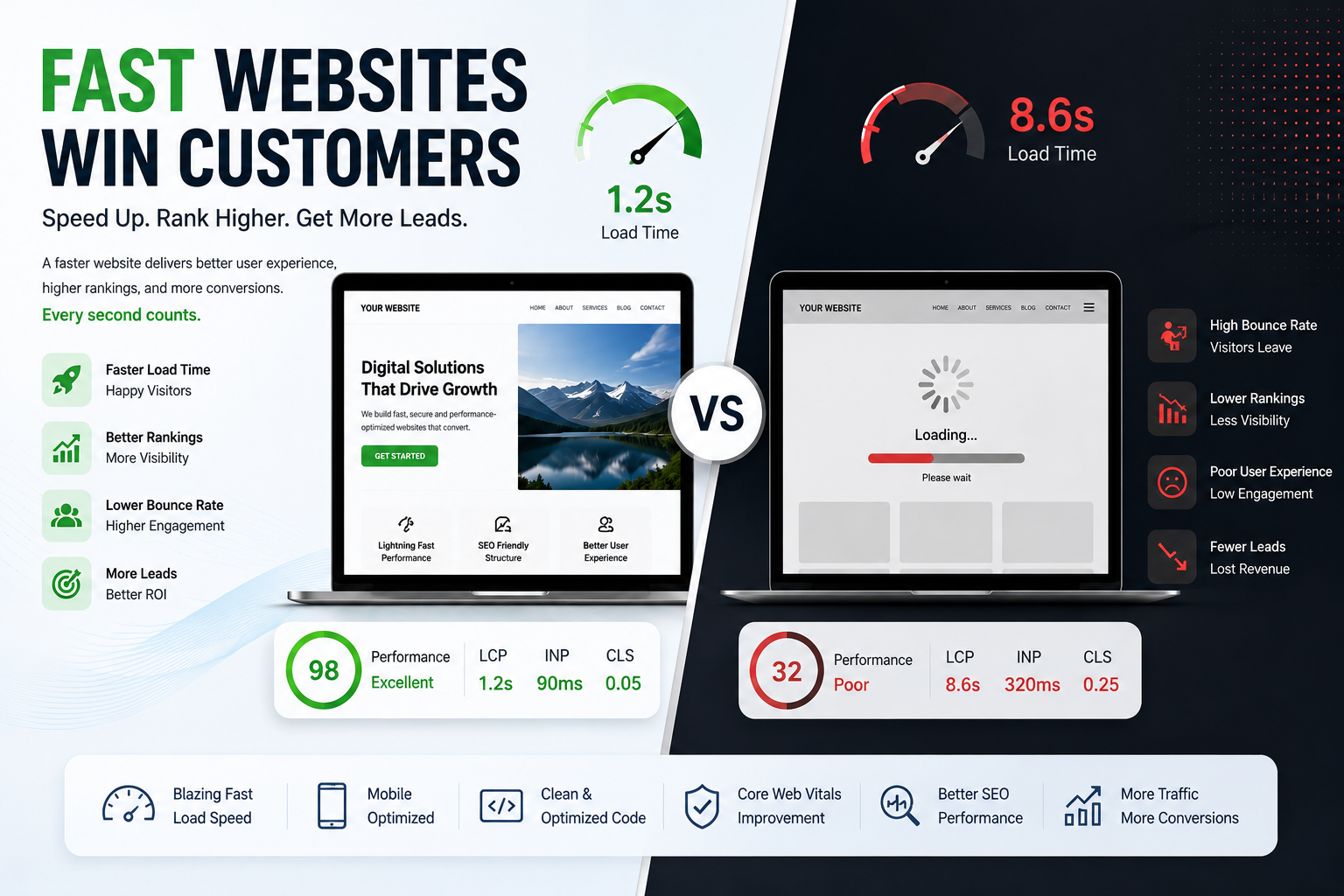
Here’s the uncomfortable truth: a slow website doesn’t just annoy visitors. It actively loses you customers before they ever fill out a form, call your number, or add something to a cart. Research from Google found that as mobile page load time goes from one second to three seconds, the probability of a visitor bouncing increases by as load time approaches ten seconds — and it climbs sharply well before that. In this guide, you’ll learn exactly how page speed impact on conversions works, what’s considered “slow” in 2026, how to diagnose the problem on your own site, and the specific, practical steps to fix it — without needing to be a developer.
Why Website Speed Matters for Lead Generation
The data behind slow website costs leads
Independent studies from Google, Portent, and Deloitte all point to the same conclusion: speed and conversions move together, almost linearly.
- Website conversion rates drop by an average of 42% for every additional second of load time between 0 and 5 seconds, and by 2.11% per second between 0 and 9 seconds. Website conversion rates drop by an average of 4.42% for each additional second of load time between 0 and 5 seconds, and by 2.11% with each additional second of loading time between 0 and 9 seconds
- A two-second delay in page load time increases bounce rates by and if a page takes longer than three seconds to load, 53% of mobile visitors will leave
- Ecommerce sites that load in one second see conversion rates roughly three times higher than slower-loading equivalents, according to Portent research, and Portent’s study found sites loading in one second convert at around 39%, dropping to about 18% at six seconds.
- B2B sites that load in one second have roughly three times higher conversion rates than sites taking five seconds, and five times higher than sites taking ten seconds On mobile, every additional second of delay can reduce conversions by up to 20%
- Rakuten 24’s 2023 A/B testing after fixing render-blocking resources and optimizing JavaScript and images produced a 53.37% increase in revenue per visitor, a 33.13% increase in conversion rate, and a 15.20% increase in average order value.
- Vodafone’s controlled A/B testing found that a 31% improvement in Largest Contentful Paint led to an 8% increase in sales.
This isn’t a “nice to have” statistic. It’s a direct, causal relationship businesses have proven and re-proven across industries, geographies, and years of testing.
Why does a slow site lose trust, not just patience?
People subconsciously associate speed with credibility. A page that loads instantly feels professional, secure, and well-run. A page that stutters, jumps, or takes ages to load feels — fairly or not — cheap, outdated, or even unsafe to submit personal information to. That perception matters enormously for lead generation, where the ask is always some form of trust: “Give me your name, email, or phone number.”
Benefits of a Fast Website
A faster website compounds value across almost every part of your marketing:
- More leads from the same traffic. You don’t need to spend more on ads — you convert more of what you already get.
- Lower cost per lead. Since your conversion rate rises, your existing ad spend and SEO traffic stretch further.
- Better search rankings. Google uses Core Web Vitals as part of its ranking signals, especially for mobile search.
- Higher-quality first impressions. Visitors judge your credibility within seconds — literally.
- Reduced bounce rate, which itself feeds back into better engagement signals and improved rankings over time.
- Better mobile experience, which matters given that most B2B and local-service searches now happen on phones.
- Improved ROI on paid campaigns, since a slow landing page wastes ad spend on visitors who never see your offer.
Get To Know Us
Frequently Asked Question
A slow website increases the chance a visitor leaves before they see your call-to-action, form, or phone number — directly reducing the number of leads generated from the same amount of traffic
Research shows conversion rates can drop by roughly 4.42% for each additional second of load time between 0–5 seconds, meaning even small delays add up quickly.
Generally, anything over 3 seconds to load on mobile is considered slow enough to noticeably increase bounce rate. Google recommends a Largest Contentful Paint under 2.5 seconds for a "Good" score
Yes. Core Web Vitals are part of Google's page experience signals, particularly influencing mobile search rankings, though content relevance still matters most
For most businesses, yes — mobile traffic typically makes up the majority of visits, and mobile users are more likely to abandon slow pages due to smaller screens and variable connection quality.
Yes. Slow landing pages can lower your Quality Score in Google Ads, increasing your cost per click while simultaneously reducing the conversion rate on the traffic you're already paying for
Unoptimized images are the most common culprit, followed closely by excessive third-party scripts and slow, low-quality hosting.
Use free tools like Google PageSpeed Insights, GTmetrix, or the Core Web Vitals report inside Google Search Console for real-user data
Not necessarily. A redesign can make a site slower if it adds heavier images, more scripts, or a bloated page builder without a performance-first approach
Monthly at minimum, and immediately after any redesign, plugin update, or new marketing tool integration
Yes — studies show B2B sites loading in one second can see conversion rates roughly three times higher than sites taking five seconds, similar to patterns seen in B2C and ecommerce
Some improvements (image compression, removing unused plugins) can be done without deep technical skill, but structural fixes — hosting, code-level optimization, caching configuration — usually benefit from a professional website performance audit.
Conclusion
Every second your website takes to load is a second your prospects are deciding whether to stay or leave — and the data makes clear that most of them choose to leave sooner than businesses assume. Website speed and lead generation aren’t separate marketing concerns; they’re the same conversation. A slow website doesn’t just look outdated — it silently and consistently costs you real, measurable leads, week after week.
The good news is that this is one of the most fixable problems in digital marketing. Unlike rewriting your entire brand strategy or chasing algorithm updates, performance optimization has clear, well-documented steps and produces results you can measure almost immediately.
If you’re not sure how your website is really performing — or how much it might be costing you in missed leads — Nibble Software helps businesses diagnose and fix exactly these issues, from Core Web Vitals audits to full-site performance optimization and conversion-focused web development.
You don’t need to guess. A short conversation and a technical audit can show you precisely where visitors are dropping off and what it would take to fix it. Get in touch with Nibble Software to talk through your website’s performance and lead generation goals.